I am often asked if I teach classes at my studio. The answer is no, I don't - I'm really not set up for that - but I do teach at Portland Pottery. That's an hour away for folks in Central Maine, so I often direct people to Kennebec Clay Works. Their membership rolls are almost full, though, but now we have a new option!
Work in Progress in Lisbon opened in May. The owner - my friend & the longtime studio assistant at Portland Pottery - is Teresa Pennington. WiP is offering memberships, one-on-one instruction, and beginning to intermediate classes. There's also a little gallery that sells Teresa's work.
Monday was our first day of classes at Portland Pottery after our long break due to the pandemic. Classes are smaller, only 9 students, and everything is rearranged to allow 6 ft of distance, and - of course! - masks are required in the studio. Bottles of sanitizer and liquid soap are everywhere, and the garage door and windows are thrown open. Maine. like several other New England states, is going in the right direction on Covid-19 infections; the number of new cases has been falling for some time now. That said, within Maine, Cumberland County (where Portland Pottery is located) is still the hottest spot for contagion - unlike Kennebec where I live, which has few cases and no know community transmission. The students, bless them, were all co-operative in wearing masks and other precautions.
Am I a little anxious about being in close-ish quarters with groups of people I don't really know? Yeah, a little bit. Masks are imperfect, aerosol contagion, blah-blah-blah. I don't know if there are enough precautions in the world to make me feel 100% safe, but rationally we are about as safe here in Maine as it is possible to get, in the US anyway, and we can't stay in forever. Portland Pottery closed even before Governor Mills order to do so, and I trust if things go south they will do so again.
Aside from that, Mrs. Lincoln, how do you feel about being back in class? Gotta say, I LOVE being back. I didn't know how much I missed my community until I was back in it. A beginning student made a breakthru in class yesterday (small, hard to describe - had to do with centering hand position) and I had forgotten how much I LOVE being a part of moments like that. So, yeah: happy and excited, in addition to anxious.
My art fairs are of course all still cancelled, and the stores that carry me are not, by & large, having a great season, so I am still not sure how this winter is going to work out, but for now we are ok; more than OK, moving forward. I did get tired of reminding people in public spaces to distance, so I designed a t-shirt:
I have an order to deliver (YAY) and a firing scheduled next week. I continue to keep the rest of the country in my thoughts as we all struggle towards the light at the end of the tunnel.
Amaco Velvet underglaze on Waxy White Glaze (recipe below), on Laguna's 900 claybody
Students are like those fabled bumblebees that didn't know they couldn't fly; sometimes they don't know they can't do a thing, so they go ahead & do it, and we all learn something! That happened in one of my classes last week.
If she had asked me, I would have told Jesse not to do it; putting underglaze on top of glaze, I would have predicted, would have crusty, unpleasant results. And I would have been so wrong! She did it, and - surprise! - the underglaze maintained its brilliant, right-out-of-the-jar colors, but took the waxy sheen of the glaze. Not all of them - blue turned watercolor-y and periwinkle, the black & brown were...not great - but the hot colors were amazing. Red & orange & yellow like I've never seen in reduction. So I tried it, with the few underglazes I had lying around, and had the same results! All of the underglazes used were Amaco's Velvet series; I applied mine in 3 coats. (Jesse didn't know exactly but she said "thick." I used Flame Orange, Radiant Red, and Royal Blue. As you can see, the Royal Blue turned more of a watercolor-y periwinkle; the others are right-out-of-the-jar hues.
Amaco's velvet underglaze on Waxy White Glaze on Laugna's 570 porcelain
We only tried one glaze (so far!), and that is this one:
Waxy White (not sure the origin, but I got it at Portland Pottery)
^10 reduction
I do these weekly challenges with my students. This session I am tying each one to the week number; week 1 we have a one-pound challenge, week 2 we'll have a 2-pound challenge, and so on.
They wouldn't be challenges if they were easy, but they are doable! You will need to get all the clay up into the wall for this to work - no extra thickness at the bottom! Some tips:
The centered hump of clay should be relatively tall & narrow, with a flat top, before you open it. About 3" at the bottom, 2" at the top.
Open with your thumbs bent & pointy.
Establish a flat interior bottom before you begin pulling up
Make sure you begin your pull with your outer fingertips right against the wheelhead.
At the beginning of each pull, press in with your outside fingertips (for me that's my right hand) to make a little ridge of clay that you will bring up the wall.
As soon as you begin pulling, move your outside fingertips so they are putting pressure a little bit higher than your fingertips inside the pot. This will prevent the wall from spreading outward.
I had a date on Friday, with my community! I gave my students at Hallowell Clay Works an assignment, to make a serving dish perfect for a specific food, then make that food & bring it to our studio-wide potluck. I of course also brought a dish, in a dish; I made a tomato & cucumber salad. We expanded the invitation to the whole studio, so we could meet the people who make the beautiful things we're been seeing on their shelves.
Most of the time I write about being a studio potter, but I am also a ceramic educator. I've successfully built or had a hand in building ceramics programs at three or four institutions now; in a couple of cases the programs doubled in size during my tenure (not all down to me, of course, but I did my part.) I find that the key is community. Clay has a really steep learning curve! It's easy for students to get frustrated and give up when the beautiful items they dream of making remain out of reach for months and months. What keeps people coming back, to pay money to be frustrated over and over again? Community.
Friends. Encouragement. People to tell your stories to. People to commiserate with when things don't go well, and to cheer for and with you when they do. I have come to realize that my main contribution as a ceramic educator is not merely to teach people how to make stuff, but to knit together communities of supportive friends.
Almost 20 years ago, Robert Putnam wrote a book called Bowling Alone: The Collapse and Revival of American Community. In it, Putnam describes the decline of social capital in the late 20th century, with decreasing participation in activities and groups that pull people outside of their existing in-groups. Bowling Alone was written prior to the existence of social media, but I tend to think, despite its name, that social media has the effect of dividing us further rather than bonding us. People we don't interact with in mundane ways can be reduce to one point of view we disagree with. Thus we grow ever more isolated in smaller and more limited circles. So what, tho, right? The answer:
But does it really matter that social capital is declining? Putnam argues that, indeed, it does, as social capital "has many features that help people translate aspirations into realities." (p 288) Putnam identifies five such features. First, social capital makes collective problems easier to resolve, as there is less opposition between parties. This results in improved social environments, such as safer and more productive neighborhoods. Second, it makes business transactions easier, since when people trust each other, there is less of a need to spend time and money enforcing contracts. As a result, economic prosperity increases generally. Third, social capital widens our awareness of our mutual connectivity. This can improve the quality of our civic and democratic institutions. Fourth, it helps to increase and speed up the flow of information, which, in turn, improves education and economic production. Finally, social capital improves our health and happiness through both psychological and biological processes which require human contact.
In particular, in 2019, we are politically polarized as we've never been before. We need places where we can come together and see the whole person, not just their ideology. Places where we can experience our commonality. We need community.
Art is positioned to serve that function! In fact it happens naturally, but I've learned in my role as instructor that I can foster and nurture the bonds that create community.
That's what Friday night was. A bunch of fun people, great food, and the salvation of our society.
This one has been on the list in my head for a looooooong time; although to be fair, it is a long list. It finally came to be as part of a class project.
I have many, many repeat students at Portland Pottery. They know how to throw and slab build and attach handles; in many ways, they are grown-up potters! (They are, in fact, grown-ups, all; I am not currently teaching any kids classes.) It's easy for students, having gained enough skill that they are pleased with their results, to coast along at a static skill level. To break that plateau and insure that they continue learning and continue improving, I often create skill challenges to give them a little push.
This one was a challenge to make a pot that would be taller than 18", after firing. In my case I achieved this with three bottomless thrown cylinders stacked together - the bowl was fired separately. I haven't yet epoxied it in place. I intend to, but right now the fit of the foot into the rim of the stand is enough to keep it secure.
The exterior is unglazed, with just a little iron oxide to warm up to color of the clay.
People often ask if I offer classes. I teach, but not at my studio. I'm not set up for that, and more than that I am far, far too much of an introvert to feel comfortable with other people in my space on the regular. Just in the last year or two introversion has become fashionable, with entire articles written about how to interact with us, as if we were some rare species of gnu that might shy away or bite if not handled properly. Or maybe an orchid, that would wither if exposed to too much personal interaction.
These articles make me laugh - I promise you, you've been successfully interacting with introverts all your life without an instruction manual! I'm not a fragile flower (although I am a snowflake, I must be, strangers [mostly unpleasant ones] tell me so every single day!) and I don't require delicate handling. I do recharge myself with alone time, and being social is work for me. But as I often say, anything worth doing is a lot of work! Some things which are work are also fun.
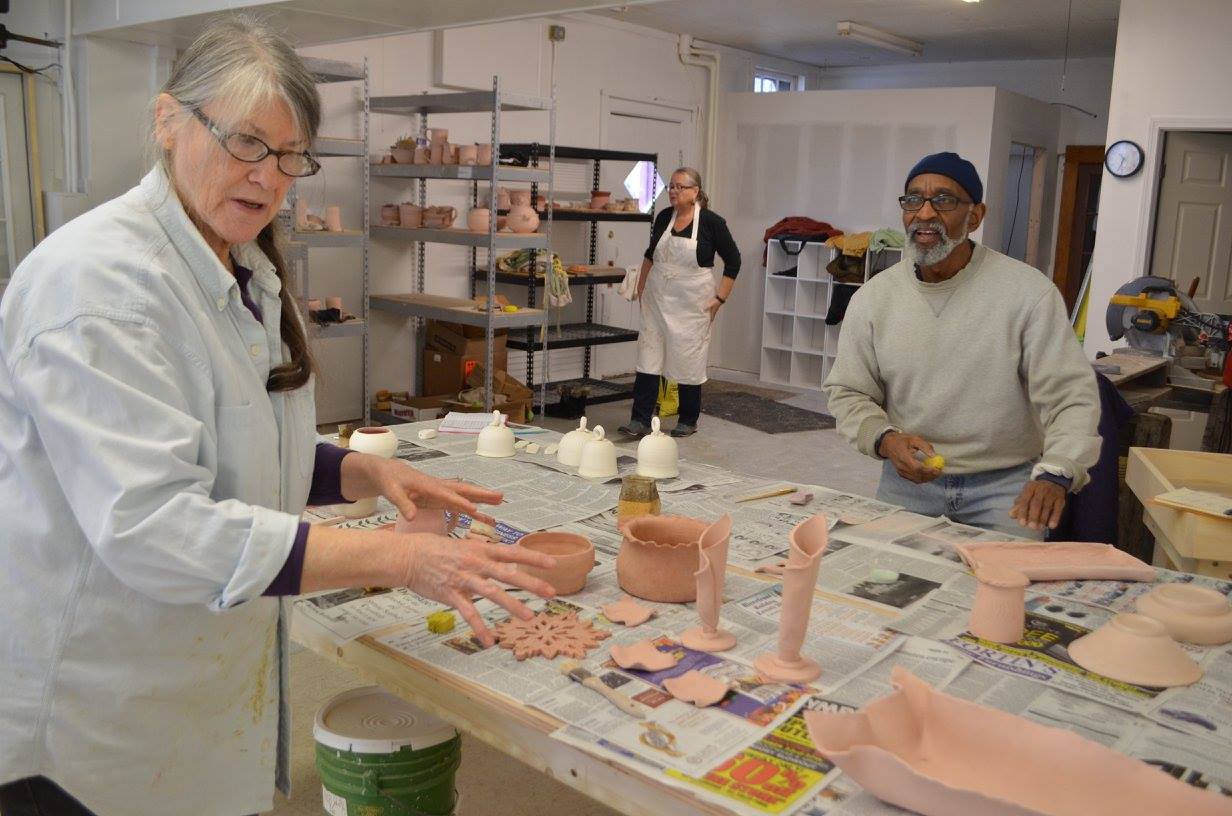
ANYWAY. Got off track. As I was saying, I don't offer classes here, but I do teach a few classes at Portland Pottery. I teach adults, at mixed skill levels. Beginners are the easiest - anything I show them advances their knowledge. ANY project will grow their skills. My later intermediate & advanced students are trickier; I want to help them pursue their own projects but I also want to push them a little. It's easy when you are finally making things you like to stop striving for new skills - that's why you need a teacher.
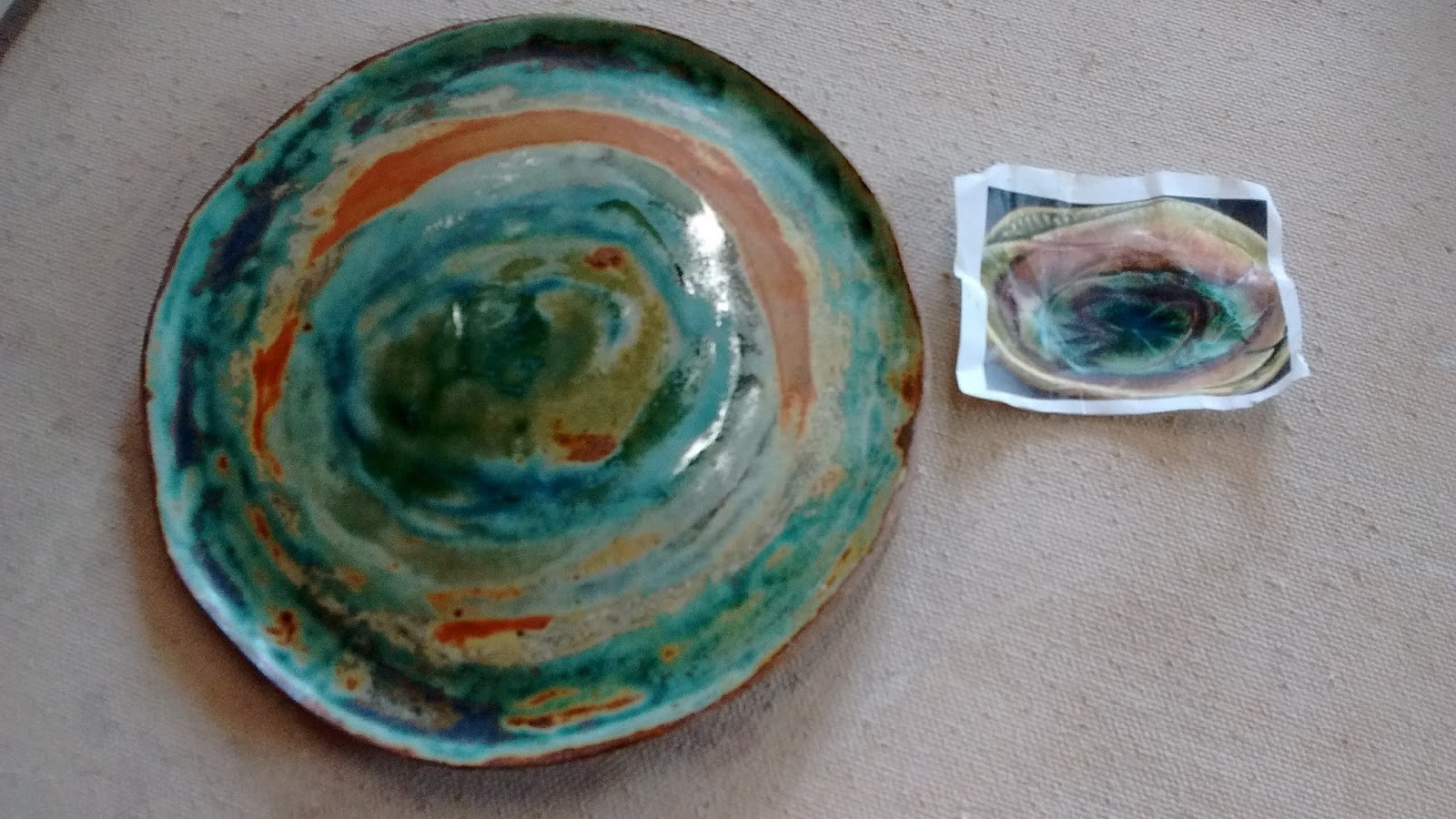
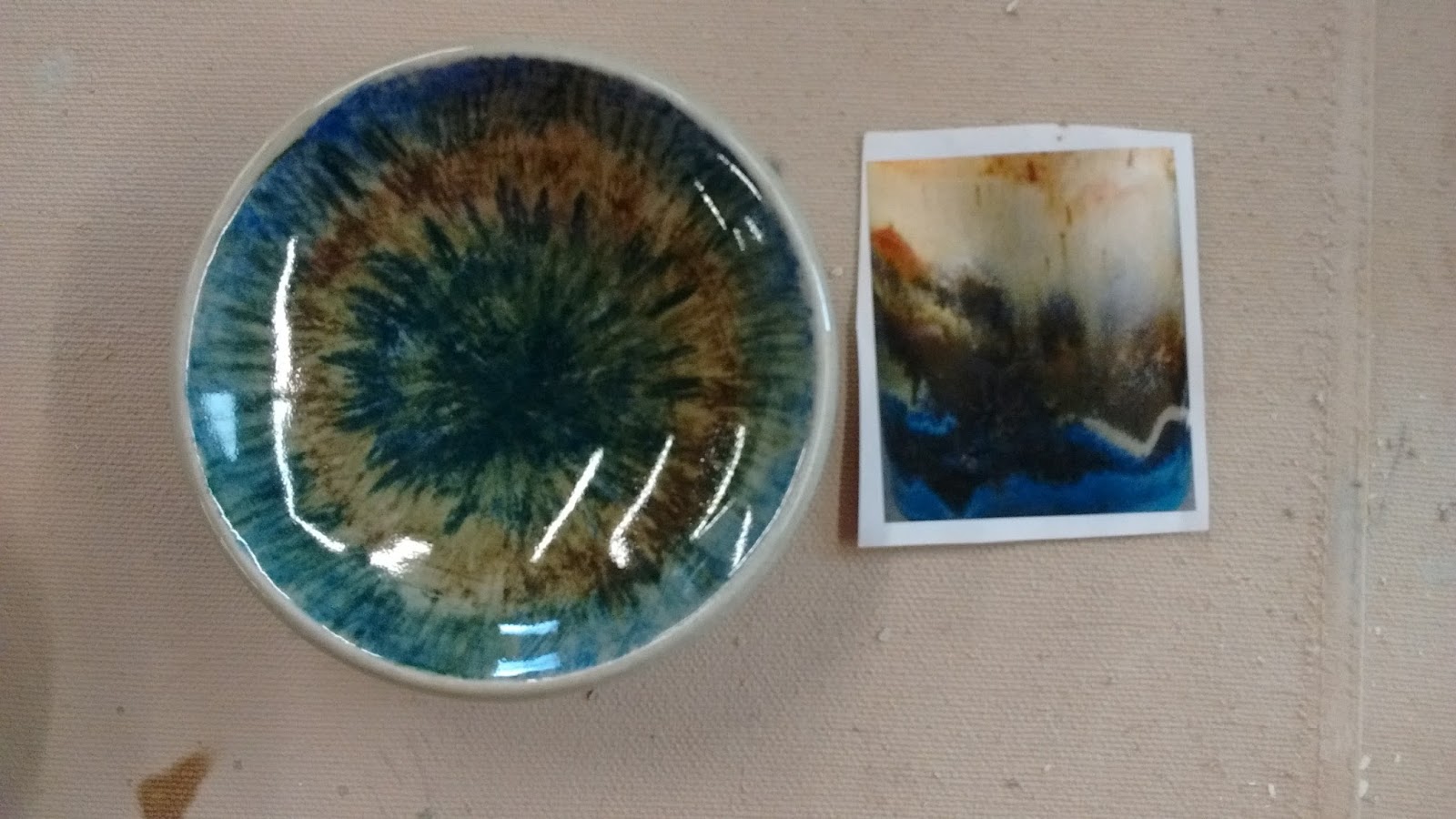
Our latest class project was designed to push people to try new surface treatments. I found and printed out some color/ pattern swatches, snipped them to about 2" x 2" so they wouldn't be recognizable as paintings, fabric, ceramics, or whatever. I put the bits of paper in a bowl and had students reach in & pull one out. That then was their assignment: replicate that as a ceramic surface, using any method available. Here are some of our results:
I am missing a few - I swear I took photos of all of them but somehow the photos are nowhere.
Underglaze was a popular approach, and some people tried underglaze crayons for the first time. There were wax/latex patterns, and brave efforts to try and apply glazes in such a way as to replicate the look.
I often do some version of a class project, and thins was one of my favorites! It was great fun for me to see the different approaches people took. I will find ten more snips online, and we will do this project again.
A mind is like a glaze recipe: you throw in ideas, give them some time and energy, and they blend to create something new.
I've been cogitating on a handful of stories I encountered around the same time, and in my mind they are fitting together to form thoughts. First was the Roberto Lugo video I shared earlier; it's powerful, and one of the ideas Lugo discusses is the power of ceramics to bring people together. Second is this story out of Nebraska, about a man who hated Muslims until they became his neighbors, and in getting to know them he found his heart changed. And the third, sadly, is about the distressing events this week in which nearly 70 Jewish community centers had to be evacuated because they were the targets of bomb threats.
Yeah. That happened, in our America.
Like so much that has happened lately, I feel powerless to do anything about it, but I don't feel like I can just say, "Oh, yeah, a bunch of Nazis threatened to bomb my friends, neighbors, and compatriots, totally normal, no big, let's talk about my wacky burner situation!"
It's not totally normal, or any other kind of normal, and anyone who has any kind of a platform has an obligation to say so. My Republican friends keep saying "Just because I am conservative doesn't mean I am a bigot" and I believe them - so this is for them, too. All who reject bigotry as an American value should condemn this intimidation campaign. Politics is one thing, but surely all reasonable people can agree on rejecting Nazis. Our grandparents fought and died for this!
(This goes without saying, but if you are a Nazi, or any other kind of bigot, you should boycott this blog! I totally deserve to lose your readership, so buh-bye.)
Which brings me back to my thesis: in clay I see one road to an understanding of our shared humanity.
I taught my first pottery class in 1994. Over the years, I have had thousands of students, of a broad variety of races, ethnicities, sexual orientations, and religious persuasions. I currently have many Christian and Jewish students, and a handful of Muslim students, and of course many whose beliefs are unknown to me.
I have never once observed or overheard bigotry in the clay studio.
It may be that clay just attracts a certain good-hearted kind of person, but I think the causality goes both ways. Like the Nebraska man who found he didn't hate Muslims once he actually knew some Muslims, it's hard to hate a person who seems just like you. In clay class, students all struggle with the same challenges: learning to center; oops, collapsed; how do I get this dang handle to stay on; rats, it cracked in the firing; yikes, massive glaze run! And we celebrate successes together: Look, first handle! Biggest thing I've ever thrown! Kiln unloaded today, show everyone your beautiful pots. Clay studios are tight-knit communities, and communities have the power to transcend differences. We make dear friends based on our shared enthusiasm and experiences.
Now I hope we can take the love we've grown in our clay spaces into the wider world. A Jew, a Muslim, a Christian, and an atheist walk into clay class. They talk, they laugh, they commiserate and they encourage one another. They walk out friends. They take that friendship into the world, and become a shining example of what can be when we recognize that we are all just people.
Keb Mo says it better:
Well I feel just like you
and I cry just like you
But I heal
Just like you
and under my skin
I'm just like you....
While visiting my friend, Malley Weber, at her new teaching studio, I saw the greatest idea! Check this out:
That's plaster, in a Flexible Flyer! What a great way to make a large platter mold. Alternatively, if you aren't into plaster in the studio, you could use the Flyer itself, with some cooking spray or a length of fabric, as a slump mold.
As it turns out, this form will be used to make wall pieces for an upcoming show at the Harlow Gallery - practically right across the street from Malley's new space. Which, BTW, is an absolutely fabulous studio. This is me right now:
LITTLE JELLIES
Students glazing
Check it out:
If you are looking for pottery classes in the Augusta/ Hallowell area, Hallowell Clayworks is the place to be. Click here for more info, or check out the Facebook page.
In the meantime, Flexible Flyers are easy to find this time of year! Time to start cranking our some slab-built platters. (Building that large, remember to obsessively compress! Sorry, it's automatic, couldn't stop myself.)
The New Year is in full swing now: classes have begun at Portland Pottery! See all the busy bees in my Monday night beginners' group.
The session that begins in January is usually the slowest of the year, but not this year. My classes are all full, with the exception of a couple of slots on Tuesday afternoon. Looking forward to a full, fun, creative year sharing my passion.
You know who I love? Karen Dicenso! Karen is the voice on the phone (one of them) when you call Portland Pottery. (Like, say, when you call to register for the upcoming Raku Workshop! Seriously, do, it's gonna be fun.) She also teaches in the adjacent classroom during my Thursday pm class. We trade ideas back & forth.
Last week she had a good one: she brought a painting stencil to class, along with a "pounce" brush, and underglazed a slab with it. She then used that slab as the bottom of a thrown and altered form, and also to build a mug with the pattern on the inside. I loved the crisp qualities of the stencil image juxtaposed with the softness of the thrown oval, and the natural handbuilt wonkiness of the mug. I'm all about those tensions: human vs machine, tight v loose.
I wish I had taken a photo, but I didn't. Here's my version, though. I used thick porcelain slip instead of underglaze, to get more of a raised pattern. I also used a natural sponge to try and create more of a lacey texture; not sure how successful that was.
Because I all about those contrasts, the next time I tried this technique, I wanted to introduce a different quality of mark-making - my fave, slip-trailing. So the stenciled slip decoration is crisp, the trailed slip is squishy...I am sensing some possibilities here.
You can see the "pounce tool" here, in the slip cup. I use quotes because it's really just a bit of foam rubber on a stick! But it really does work better than a brush. You can get them literally anywhere. Okay, not literally: there probably isn't one in your coffee cup or nder your mother's couch cushions, or even at Hannaford. But any craft supply store will have them, as do Home Depot & Target.
This technique works best if you can stencil onto a flat slab - my efforts to stencil onto a thrown piece were...messy. It might work better with a small stencil, or a stencil cut from more flexible material, like maybe tyvek paper.
Those commercial stencils are all fine and good, but the thing I am really excited about? I bought a pack of blank stencil sheets! I also bought an exacto knife - those of you who know me know I am not fond of them, too many bad memories - but a friend told me they cut better with a woodburning tool, which I already have.
Going to try to create a stencil that captures the delicacy and profusion of bleeding hearts. Photos soon! I hope.
Did you find this post useful? Drop a dollar in the tip jar in the column to the right!
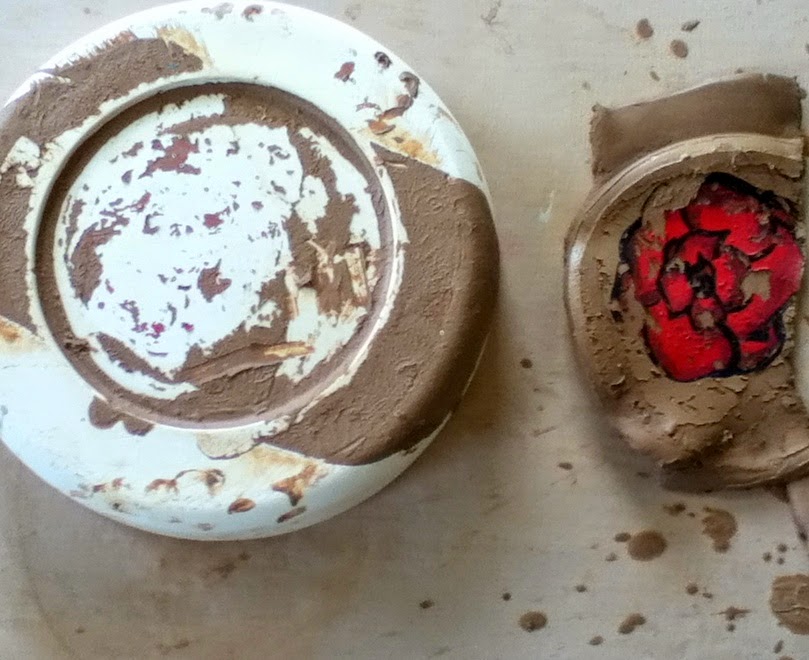
I tried out Chris Dufala's monoprint technique last night in class. (I have a long standing tradition of trying things for the first time in class. Hilarity ensues! Sometimes.) Chris has a detailed step-by-step at this link, which is way more helpful than my fumbles might be, so I'll just briefly describe what I did:
Paint an image on plaster. You have to think backwards, because whatever you paint first will be the top layer. So, the black outline and shading on the rose was what I painted first, and then the red behind it.
Let it dry to not-shiny. Pour thin slip of the claybody you are using over the image - a thin layer! My first mistake was using too much slip.
Slap an already-rolled slab quickly onto the slip layer. I found it helpful to compress the slab downward with a rib or fingertips. Maybe a roller.
Peel the slab up. God willing and the creek don't rise, your image will be on the other side!
My images only partially transferred, giving them a deteriorating, peeling-wallpaper kind of look.
You all know how I love the Law of Entropy! Deteriorating patterns & images are what makes my world go 'round. So I loved the little slab images too much to throw them away but they weren't big enough to make something out of themselves, so....Throw a pot to use them on!
This is what I love about going to NCECA, and workshops generally: when you can take someone else's technique, and use it to make your own work stronger. It's nothing like copying - what I make couldn't be further from what Chris makes, and the uses I hope to put this to are completely different from what he is doing.
Though this was an off-the-cuff pot, I can see this in future "real" work (as opposed to demos.) Maybe not with the tear-throughs...maybe cut windows, looking through at a peeling floral pattern.
Whatever it ends up being, you'll see it here first!
Though I'm in the firing end of the making cycle in the studio, I am still doing wetwork demos for my classes. This platter is made by securing cloth over the top of a container and then draping a thick slab over it. Some call it a sling mold (say this in the voice of Billy Bob Thornton.) I like sling molds because any size platter you want to make, there is a container in the world that will serve as the mold for that platter. Look in the home storage department at Target for larger ones, or in the food storage aisle at the grocery store for smaller ones. This one if held in place with rope but a big rubber band would work or, if your mold is wood or cardboard, you can staple the cloth in place. I leave the clay quite thick - maybe 5/16ths inch. I hate a flimsy platter.
If I catch this platter at the exact right moment I won't need to put a foot on it: I can just take it out of the mold and tap it on the tabletop to flatten the bottom. If I miss my moment, I'll throw a ring for the foot.
It was two demos in one: I showed my students how to make the sling mold, and then used the platter I made to show them a couple of slip techniques. The checkerboard pattern I made by cutting squares of newspaper and sticking them to the damp clay, then brushing white slip over them; the flowers are a brush embroidery technique.
But that was yesterday, and yesterday's gone. Today I a back in the glazing/firing end of the cycle. I'll be applying flashing slip and waxing pots all day.
You know the one. Maybe it's you. The student who struggles time after time, collapsing pots and making misshapen lumps. The student beside you seems to sail effortlessly forth, her very first efforts round and smooth. I've seen you both before, and I am here to tell you, it's okay.
Hand-eye coordination is not talent, and should not be taken as a measure of your potential as a potter. I've taught clay for twenty years, and I can say, early skill makes no difference to the kind of potter you'll become. The truth is that anyone with sufficient patience can master the skills of throwing, handbuilding, glazing, firing. If you want those skills, they are yours, if you devote the time to it. For some it will require a greater tolerance for frustration. That steep initial learning curve looks daunting, and it is steeper for some than others, but it is the least part of your life as a potter.
The differences I see between students who go on to become fine potters and students who either wander off into other interests (nothing wrong with that!) or become makers of dull ware are: a love of the material and intellectual curiosity about it; a deep interest in process; and a willingness to make the extra effort to make the work good. The detail work, the exploration, the mindfulness, the willingness to risk failure: these are the things that lead a potter to fine work. Early skill? Not so much. It's not a hindrance, I'm not saying that. It just doesn't matter.
In fact I kind of hate the word talent. It implies a kind of some-got-it, some-don't fatalism. There are the Picassos of the world, people whose minds work so differently that they change the way we all think about something, but they are so vanishingly rare they need have no part in this discussion. If you think you need to be the Picasso of clay - or if you think you are the Picasso of clay - you're wrong. Okay, technically, somebody reading this could be the Picasso of clay: see again vanishingly rare. And that's okay.
Keep throwing. Keep making. A little extra time in the studio makes a big difference. Comparisons are odorous: they stink. So don't side-eye they person beside you with their tidy little board of sleek pots. They could go on to make incredible, engaging, fascinating work. Or not. So could you. At this point nothing points to the one over the other.
Yesterday was butterdishes! I had thrown and stretched these on Sunday but it was Friday before I got a chance to assemble them. They are some of my favorite things to make: enough elements to keeping things interesting, and a broad surface to decorate. It's hard for me to remember to leave something for the glaze to do! I expect these to be part of the August 15th firing.
I haven't forgotten that I am supposed to be doing a video of butterdishes. Maybe during the glaze firing. It's hard for me to make anything while the kiln is firing, for some reason.
Yesterday was also website work. I built my own, noticed that it was not that hard to do, and a few weeks ago, I started putting the word out that I was available to build websites. I had in artists in mind; lots of artists are not especially tech-y, but nevertheless need a website. People are always asking if you have one, for one thing! And if you want to show someone what you do at distance it really is still the best way. I've gotten a few responses already, and started building the first last night.I'll post links to the finished sites here, once I get the go-ahead from the artists involved.
And today? Raku Workshop!! I run a series of them in conjunction with Portland Pottery every summer; this is the second this year. The sky is looking a bit ominous...here's hoping it holds off. Maybe, like weddings, rain is good luck for the firing?
Tomorrow I am back in the studio, finishing some salt & pepper shakers and plates, and throwing for a new account: Craft Company No. 6! More on this later.
Once in a while I invite my intermediate and advanced students to play a game called Building Blocks: we each throw two "torsos" - pieces large enough to become the main body of a pot - and three to five additions - spouts, handles, feet, small cylinders that can be cut up to create other shapes. It's a valuable exercise in that it casts the wheel in a new light: more like a slab roller or an extruder. Not as a source of finished pieces but as a tool, to make shapes that then become pieces. Also, it's fun! Above is our collection of building blocks; below are some of the pots which arose from them.
I may have mentioned my new hobby? I am learning to make soap. Though any fool, including me, can make lye and fat do the Wild Thing and get something you can wash with, my soaps so far have been..fine. Well: one batch was too soft to use; one unexpectedly turned black (which was kind of cool and spa-y) and one made tiny bars because the ad hoc mold was too big. They suffer from paper crinkles in the sides, insufficient color or fragrance...in general from my lack of experience. When I am dying to make soaps like this:
See what I mean? It's fine, it smells good, it has some nice qualities...but it's not fabulous.
My head is full of fabulousness, and the wait for my skill to catch up - which might be a long one - is maddening. And then it occurred to me: this is what my students feel like. Their heads are full of fabulous ideas for amazing pottery, and for the nonce they have to be satisfied if it just doesn'tcollapse. Any fabulousness is almost accidental. They want to know, "What am I doing wrong?" and sometimes I can tell them a specific thing - "Hold your hands like this" - but more often the answer is: Nothing. It just takes practice.
Though I think I am patient enough, there's nothing like standing in someone's shoes to really foster understanding. I think it's good for my outlook, as a teacher.
Of course, it doesn't change anything. For them, and for me, fabulous takes time.
Get Exclusive Content, Discount Codes, & More on Patreon
For more videos & tutorials, early access to shop updates, and discounts on Fine Mess Pottery, become a subscriber at my Patreon page. Click the image to learn more!
Wishlist
Art tools & materials I'd love to try. Watch for posts about how these worked out.
https://a.co/6L6qZNo
Lori Keenan Watts (aka me) is a potter, gardener, and avid reader from Augusta, Maine. Though I started my university education in surface design for fabric, clay quickly grabbed me by the heart and redirected my creative impulses. I have been a potter for over 25 years -- hard to believe. The most valuable years of my ceramic education were spent in graduate study at Southern Illinois University at Edwardsville, under the tutalage of Dan Anderson and Paul Dresang.
My aesthetic is guided by my love of the material itself. What fascinates me and makes a pot compelling for me is the clay-ness of clay: the squooshiness that becomes the adamantine solidity. I also like patterns, unexpected proportions, and when the flame comes along and dissolves part of my careful decorating efforts! I am obstinate about this aesthetic, to a point which might be called pig-headed, but hey, if you don't like what you make, why bother?
My happy little family also includes my husband, musician and photographer (and author of the book Alewife) Doug Watts; five cats; and a turtle, all foundlings and rescues of one stripe or another.









 Posts
Posts

