Showing posts with label History. Show all posts

Friday, December 26, 2025

Pottery & History: The Earliest Evidence of Mathematical Thought


The craft of pottery ties us to our history, in part because the material is so durable. Pieces of the objects themselves survive, giving us clues as to the lives of the people who made them.

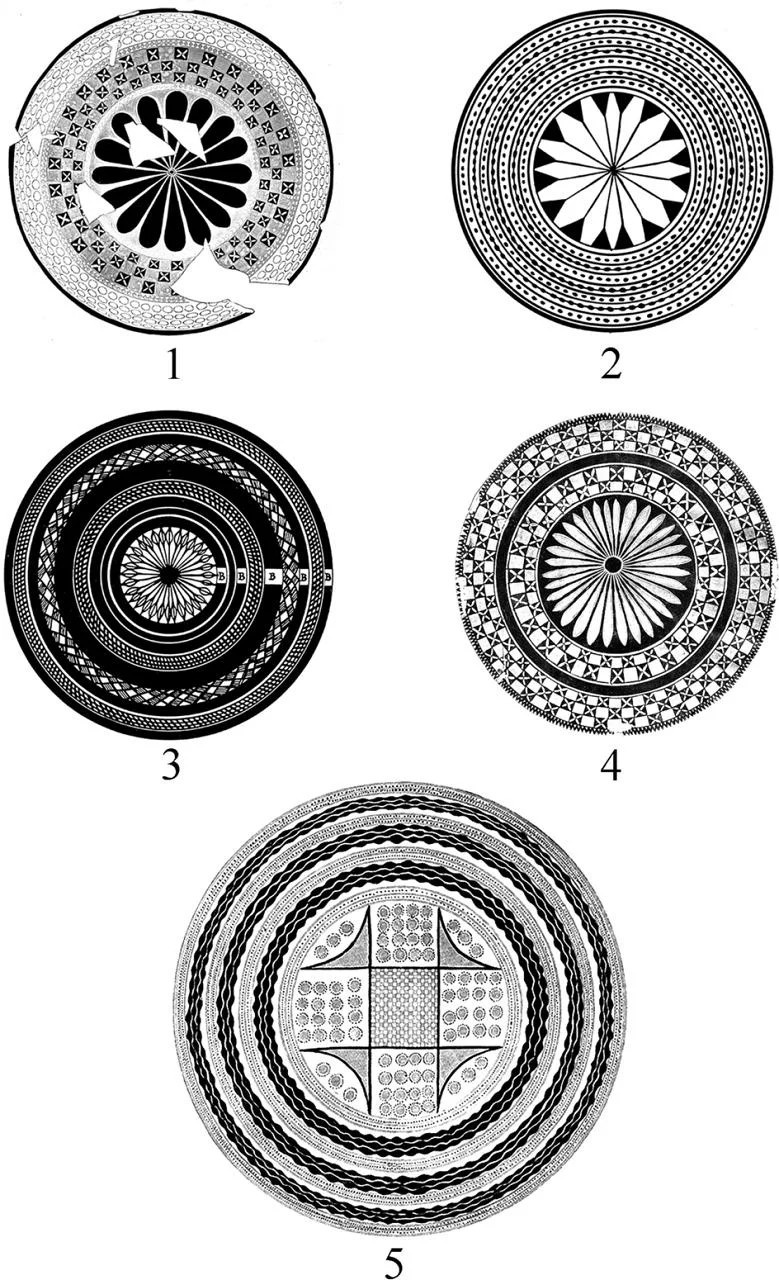
Much of prehistoric pottery, if it contains images at all, features images of animals or humans, reflecting the interests of the culture that produced it. A recent article in Science Daily reveals that Halafian pottery, from the Mesopotamian region in the era from 6100 B.C. to 5100 B.C., produced the earliest known botanical images on ware. This is of particular interest to me, as botanical imagery is sort of a specialty of mine! In Halafian ceramics, flowers, seedlings, shrubs, and branches are depicted but interestingly no edible plants, suggesting the images were purely aesthetic, rather than conveying information about agriculture or food gathering. The floral images were arranged in precise geometric patterns, indicating the makers engaged in mathematical thinking long before any known numerals or mathematical writings. The images are spaced evenly across the surfaces, and some floral images have petals arranged in mathematical sequences: 4, 8, 16, 32.
Math, science, history, unraveling the mystery! Or, if you prefer: prehistoric people! they were just like us.

Monday, November 10, 2025

In the French Tradition


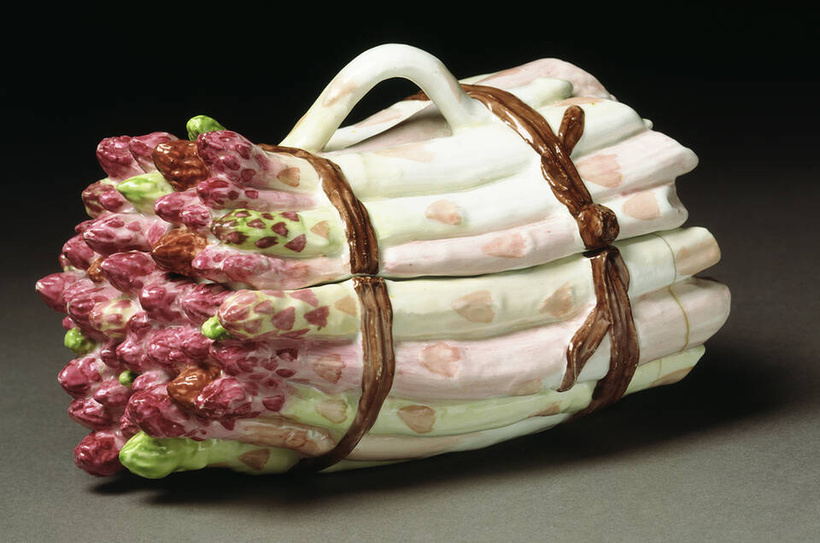
In fashionable households in 18th century France, it was common to see serving dishes made to appear like whatever they were meant to serve: asparagus soup in a tureen shaped like a bundle of asparagus; chicken casserole in a hen-shaped vessel.

Though the term used for these is trompe l'oeil, which means "fool the eye", these were unlikely to fool anyone (unlike the actual trompe l'oeil ceramics of, say Marilyn Levine or Paul Dresang.) The French vessels were more like visual jokes, all the funnier if the food within were completely different from what the exterior led one to believe. A sweet custard in a fish-shaped tureen? Hilarious! [Read more...]

Tuesday, October 26, 2021

World's Oldest Profession - One of them, Anyway!

Fingerprints point to 5,000-year-old Orkney pottery class

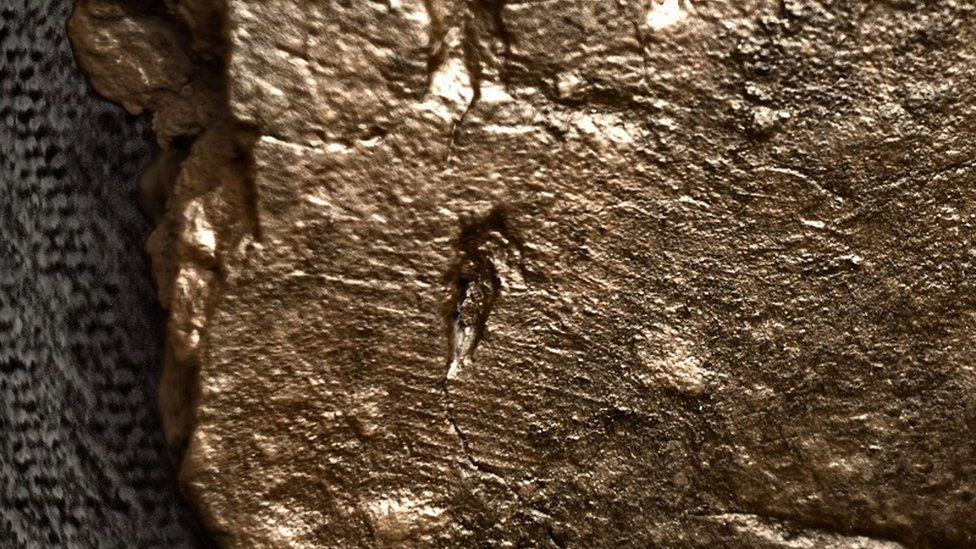
Fingerprint on a fragment of potteryIMAGE SOURCE,JAN BLATCHFORD
Image caption,Analysis suggests the fingerprint was left by a 13-year-old boy

Archaeologists believe fingerprints on fragments of clay found in Orkney were left by experienced potters and their young apprentice 5,000 years ago.

Experts have newly identified a print left by a 13-year-old boy.

Previously finger marks left by a young male, possibly the same boy, and two adult men were discovered on fragments of pottery at Orkney's Ness of Brodgar.

Archaeologists suggest the prints were left as experienced potters showed novices how to shape a piece of clay.

They have been excavating at the complex of ancient buildings at the site in the Heart of Neolithic Orkney World Heritage Site since 2003.

Only a small number of fingerprints have been discovered so far.

University of the Highlands and Islands Archaeology Institute, which leads the excavations, said the latest fingerprints were found by ceramics specialists Roy Towers and Jan Blatchford while they examined the site's huge collection of sherds - fragments - of pottery.

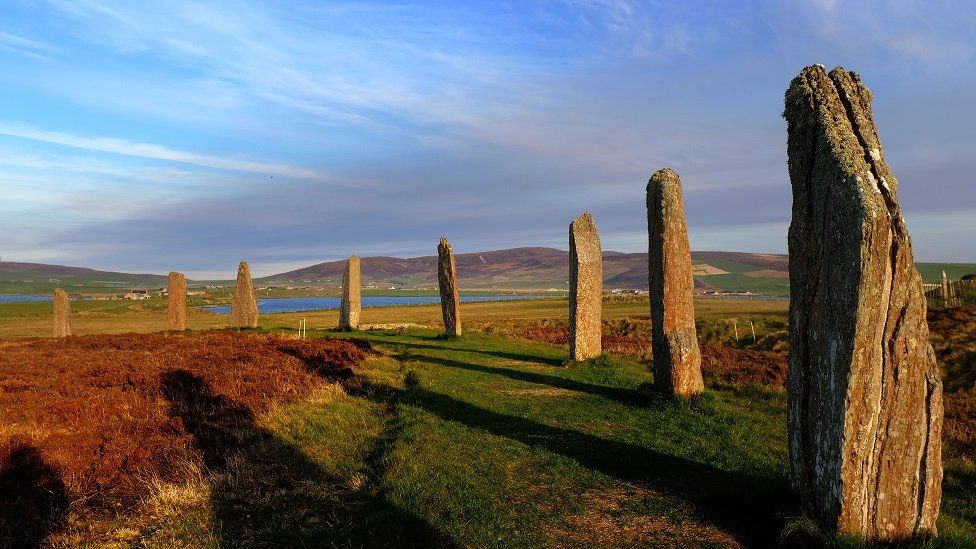
Ring of Brodgar, Orkney Islands, MainlandIMAGE SOURCE,PA MEDIA
Image caption,Orkney's Neolithic archaeology have World Heritage status

The institute said it was possible to work out the age and sex of a person from a fingerprint.

It said the distance between ridges, for example, increased as an individual grew, while male ridges were usually broader.

The latest prints were examined by Prof Kent Fowler, director of the University of Manitoba's ceramic technology laboratory in Winnipeg, Canada.

By measuring the density and breadth of the fingerprint ridges, and accounting for the shrinkage of the clay during drying and firing, he could determine two adult men aged about 19 along with one, or possibly two boys aged 13 and 14, had left finger marks on the Ness of Brodgar pottery.

Prof Fowler said: "The presence of younger and older prints on all the Orkney sherds so far is interesting and might relate to teaching and learning the craft."

Nick Card, the director of the excavations, said: "This is yet another exciting discovery at the Ness, and although it is early days we could be seeing the emergence of a pattern developing for the production of pottery in the Neolithic, which would have implications for the division of labour and tasks."

https://www.bbc.com/news/uk-scotland-north-east-orkney-shetland-59036887?fbclid=IwAR0-eVSwKgSOIs9uvRaUT6VGlb5Lmpi0JsKve5fEw-iaL_z5RddaXoFhiIY

Tuesday, December 31, 2019

Some Things Never Change

This month archaeologists made an intriguing discovery at a dig near the Israeli city of Yavne: a site of an unusual number of kilns, and at the mouth of one of the, a small jug containing seven gold coins:
A hoard of seven ancient gold coins was found hidden inside a small clay juglet during a dig in the area of Yavne, in the central region of the country, the Israel Antiquities Authority said Sunday.The coins date back to the Earlier Islamic period of the seventh-ninth centuries CE. They were found last week at the entrance to a kiln at the site.“This may be a potter’s personal savings,” the IAA said in a statement. The jug, which was partially broken, “may have been a piggy bank,” it said.
Seven coins. Sounds about right! My own personal clay bank contains more than seven coins, but not many, and none of them are gold; still the parallel remains. Part of my interest in ancient clay is the reminder that in so many ways, people are just people: so much in common even across millenia. 

The coins in Yavne were still in the bank; I hope this means the potter lived their whole life secure in the knowledge that they were there if needed, and yet they were never needed. Across the temporal distance between us, I wish that potter well

And you, too! Happy New Year!

Sunday, December 29, 2019

We Have Always Been Artists


I have sometimes told myself a little story of how people discovered ceramics: a grass cooking basket (this actually works as long as the fire stays below the water level), lined with clay to hold water better, catches fire maybe with some, I dunno, mammoth fat or something in it that would burn hot. Afterward the cook discovers something amazing: the lining of the basket is changed, is now solid and permanent in shape, and impervious (well, sort of) to water. (I have a similar story I tell myself about soap, involving fat, & lye-filled wood-ashes.)

Firing, of course, is only half the story of clay, and perhaps not even the large half. Before we learned to fire, we longed to form: to reify images in our minds.

Or so goes the story I tell myself. In fact, we can't know what our prehistoric ancestors were thinking, but we can see some of the things that they made, and some of those things were made of clay. 14000 years ago, in the cave of Tuc Audoubert, an artist sculpted these bison from the clay of the cave walls. They aren't fired, but the cave has protected them from the weather all these millennia, and though they have cracked - as a clay artist myself, familiar with all the technical things that can go wrong in the process - I'd be willing to bet most of those cracks happened in the lifetime of the artist. Yet they remain, the marks of the artist's hands still clearly visible. 

It is a shivery feeling, to imagine those moments of making, when an artist - just like you! - knelt on the cave floor, patting and prodding the clay into the desired shape. His or her life was so so different from yours, and yet inside, the same, in at least this one way.

This discovery was made in 1912 by three French brothers. Read more about it at this link!


Friday, May 20, 2016

Misty Water-Colored Memories

This photo recently appeared in my Facebook feed. It's my graduate school cohort, in 1992 (I think?), at the Wagner Complex, which was where the art department of SIUE was housed back then.Wagner is where my passion for clay really took root. That's me, in the middle, in the light-colored dress.

So many faces, so many old friends! Some I am still in touch with, some I had forgotten, one who died tragically young. It was an intense time! A community of artists, engaged every day in the practice of clay...The way I remember it, we were utterly immersed. We ate,drank, and slept clay. It was magic.

I've never done anything quite like it since then. Now I am daydreaming of a Watershed-session reunion of this group.
Good times.

Saturday, August 1, 2015

Cats and Clay, a (Very) Brief History

Yup, that's a paw print alright.
It appears cat have been wreaking havok for clay workers for at least a couple of millenia! Paw prints were found on 2000-year old Roman roof tiles, perhaps made when the tiles were laid out to dry. The tile was fired and used nevertheless - for all we know the marks were considered an embellishment! That wasn't the way of it when my own feline friends - kittens at the time - contributed to my work, but who knows? More likely, it just didn't matter, as the fairly shallow prints didn't interfere with the function of the tile.


Thursday, April 11, 2013

Ceramic Cook Pots: An Early Version


Ice Age hunter-gatherers ate fish cooked in ceramic pots


An Incipient Jomon pot from Kubodera-minami, Niigata Prefecture, Japan ca. 15,000 years old, which also contained traces of fish (Photo Courtesy: Tokamchi City Museum)
Hunter-gatherers living in glacial conditions used pots for cooking fish, a new study suggests. According to the findings led by the University of York, this is the earliest direct evidence for the use of ceramic vessels. Scientists from the UK, the Netherlands, Sweden and Japan carried out chemical analysis of food residues in pottery up to 15,000 years old from the late glacial period, the oldest pottery so far investigated. It is the first study to directly address the often posed question why humans made pots?
The question of why glacial-era humans made pots strikes me as a stupid one: because it's fun, duh. J/K. But really, is that such a mystery? If they knew how to make vessels from readily available material that could store food and other items against scavengers, dirt, and weather; keep water cool; provide a cinder-free cooking experience; and be almost endlessly reusable, why in the world wouldn't they? Why did early humans make pots? Because they could.

The more interesting question to me is, how did humans discover the fire-able quality of clay: how did human-induced quartz inversion first occur? I can tell myself a little story about a clay-lined cooking basket catching fire and getting hot enough to give someone an inkling of what clay could do, but it's only a story. Absent a time machine, guesses are all we've got.