I keep reading this phrase: dopamine dressing. I hadn't heard it until recently but I immediately knew what it meant. We've all done it! Colors that make you happy, jeans that make your butt look amazing, clothes that just feel very you & make you happy.
I've started to think of using handmade dishware as dopamine dining. A mug or bowl that you love, that reflects an attitude of joy or serenity or high energy, or makes you smile - gives you what I call joy-zings but what might also be called dopamine hits. If you improve your experience of ordinary activities - & what could be more ordinary than preparing & eating food & drink? - you've improved your daily life. And guess what? Your daily life is the only life you have!
Tl;dr: Buy & use handmade pottery. See ya at the Maine Pottery Tour, May 6 & 7!
I had a date on Friday, with my community! I gave my students at Hallowell Clay Works an assignment, to make a serving dish perfect for a specific food, then make that food & bring it to our studio-wide potluck. I of course also brought a dish, in a dish; I made a tomato & cucumber salad. We expanded the invitation to the whole studio, so we could meet the people who make the beautiful things we're been seeing on their shelves.
Most of the time I write about being a studio potter, but I am also a ceramic educator. I've successfully built or had a hand in building ceramics programs at three or four institutions now; in a couple of cases the programs doubled in size during my tenure (not all down to me, of course, but I did my part.) I find that the key is community. Clay has a really steep learning curve! It's easy for students to get frustrated and give up when the beautiful items they dream of making remain out of reach for months and months. What keeps people coming back, to pay money to be frustrated over and over again? Community.
Friends. Encouragement. People to tell your stories to. People to commiserate with when things don't go well, and to cheer for and with you when they do. I have come to realize that my main contribution as a ceramic educator is not merely to teach people how to make stuff, but to knit together communities of supportive friends.
Almost 20 years ago, Robert Putnam wrote a book called Bowling Alone: The Collapse and Revival of American Community. In it, Putnam describes the decline of social capital in the late 20th century, with decreasing participation in activities and groups that pull people outside of their existing in-groups. Bowling Alone was written prior to the existence of social media, but I tend to think, despite its name, that social media has the effect of dividing us further rather than bonding us. People we don't interact with in mundane ways can be reduce to one point of view we disagree with. Thus we grow ever more isolated in smaller and more limited circles. So what, tho, right? The answer:
But does it really matter that social capital is declining? Putnam argues that, indeed, it does, as social capital "has many features that help people translate aspirations into realities." (p 288) Putnam identifies five such features. First, social capital makes collective problems easier to resolve, as there is less opposition between parties. This results in improved social environments, such as safer and more productive neighborhoods. Second, it makes business transactions easier, since when people trust each other, there is less of a need to spend time and money enforcing contracts. As a result, economic prosperity increases generally. Third, social capital widens our awareness of our mutual connectivity. This can improve the quality of our civic and democratic institutions. Fourth, it helps to increase and speed up the flow of information, which, in turn, improves education and economic production. Finally, social capital improves our health and happiness through both psychological and biological processes which require human contact.
In particular, in 2019, we are politically polarized as we've never been before. We need places where we can come together and see the whole person, not just their ideology. Places where we can experience our commonality. We need community.
Art is positioned to serve that function! In fact it happens naturally, but I've learned in my role as instructor that I can foster and nurture the bonds that create community.
That's what Friday night was. A bunch of fun people, great food, and the salvation of our society.
Do you have a magic twanger? I do. Something in my brain that just lights up under certain stimuli. It sounds like I'm talking about a sex thing, but I'm not - my magic twanger responds to aesthetic cues. Like, making these minis! Like a lot of artists, I spend some time thinking about why I make what I make. Not why I make stuff - the inherent satisfaction explains that well enough - but why I make the specific things I make, in the specific way. The magic twanger provides a clue.
The minis give me a feeling of abundance, a sense of thriving. There are so many, all different, all the same! A healthy lilac in bloom will give me the same feeling: so much, so much bounty! Actually lots of the metaphors that come to mind are garden-related: a tomato plant heavy with fruit, bees trundling over blossoms. Teeming life.
Reading that, the word that comes to mind is "fecundity," so maybe it is a sex thing after all. 😄
One upside to my decision to keep soap in the realm of "hobby" is that, while I still sell soap, marketing for it has become far less consequential. I can have more fun with it and not worry whether I sound professional or just perplexing. Case in point: the newest soap off of the curing rack, Green Planet.
It's always been a challenge for me to describe soap scents. Top notes of this, base notes of that...does anybody know what heliotrope actually smells like? For my new soaps, I tried instead telling a little story in sensory images, that give a sense of the fragrance, instead. Like this:
I did something like this with some plates last fall; instead of describing what the plates looked like, I did a little character sketch of the imaginary person whose favorite plate this would be. (We have favorite mugs; why not favorite plates?) It worked, I guess, because I sold the plates pretty quickly...but all to the same person, so I'm not sure it's an indicator.
Still, writing descriptions like little stories is more fun. Fun isn't everything but it's not nothing either.
If this little story makes you want this soap, you can get it here. 😊
Got the new raised bed in, and filled both the new and old beds with compost.
Can I confess something that is gonna sound a little weird? I 💜 compost. I heart the idea of compost. What's basically a useless nuisance - fallen leaves, grass clippings, food scraps - turned into valuable material, just by letting it sit around in a pile! The wee beasties invisibly do all the work.
In my head, I am writing a book called The Magic of Science. (All my books, so far, are in my head. It's getting a bit cluttered in there!) Everything I love to do involves transfiguration. Professor McGonagall would be proud. The only difference is the transfigurations I specialize in involve some chemical or biological process. (I'm not as good with a wand & incantations, I'm afraid; sorry, professor.)
Lately you see people walking around in t-shirts reading "Fuck your feelings." These people, as a rule, do not seem to be big fans of science! But they should be: nothing is less sensitive to your feelings than those pesky laws of physics. You really, really liked that piece, you worked so hard on it, but it dried a bit too fast? Cracked anyway. You loooooooove copper red but didn't get the kiln in reduction soon enough? Tough titty, said the kitty. Science doesn't care if a particular outcome is convenient, or fair, or conforms to your world view. It is what it is.
Putting the greenhouse effect to work
with an upcycled window!
The laws of physics can be good and useful tools, though, if you don't expect them to be your friends.
Fats + lye + time = soap
Waste vegetation + time = compost
Clay + heat = ceramic
One of the things the proper application of those laws of physics can do is make delicious tomatoes!
I've posted four new items in the online shop - plates! Check 'em out here, here, here, and here. I've been having some fun with the descriptions. It's like a lot of things: once you give yourself permission to have fun, it gets easier.
Here's a thing I sometimes wonder about: many people like to have their own personal mug. It's not unusual for a household to have no matching mugs (is it? I've never owned a set of mugs, handmade or otherwise.) But plates? Culturally we look upon matched plates as the only way a normal household can have plates.
I want to push back on that idea, and not only because I like to make plates but I hate to make sets. I think it's an opportunity to appreciate plates as object d'art. Each plate its own little vignette, a circular frame around an arrangement of texture, color, and pattern. It's a chance for creative hosts to mix styles and colors together to create an artistic table. Plates are also naturals for display storage; on plate rails or in glass-front or open shelving.
Matching plates? So five minutes ago. Set your table with plates as individual as the people using them!
PS. Don't forget: type in discount code BLOG BUDDY to get 10% off!
There was a super- juicy area in this last kiln - no dry spots (YAY) but there was a region that got heavy soda, so much glaze it flowed in rivulets on some pots. As it does when it's fired in reduction, the thick soda glass turned charcoal...wait, no, silver...what's another pretty word for grey?
I just mean - in selling these pots, I never describe them as just grey. Dove grey, maybe, or pearl grey. People think they don't like grey. Shopkeepers think people don't like grey. But these pots, with their juicy grey rivers of soda? Are flying out of here. Every time I post one it's gone in an hour. (KNOCKS WOOD, really hard. Nothing to hear, here, jealous gods, move along!) So I only have one left, of the mugs from the super-juicy spot in the super-juicy firing. It has some grey, flecked with gold.
Why are these the mugs in huge demand, in a world where bright colors are king? I have some thoughts about this, about how people make aesthetic judgments.
There may be some aspect of aesthetics that is hardwired - a preference for bright color would make it easier to find food: fruit, obviously, and edible flowers; and flowers can mark the locations of edible roots, or, later, berries. It must be a pretty mild preference, though, (if it's there are all) because historically plenty of cultures have favored neutrals and muted tones. Most of our aesthetic is formed by what we see every day. And what we see every day is formed by our aesthetic. It's a feedback loop. But there are little cul-de-sacs of preference that form when people spend a lot of time with a less-mainstream aesthetic.
The people who bought these magical grey, wonky, fluid mugs? All people who, while not potters, have spent some time looking at and thinking about handmade ceramics. For most people, their ideas of what is beautiful are shaped almost entirely by machine-made objects. Things that are asymmetrical in form or surface, things which have uncontrolled aspects, these look weird or flawed to most people. The same for colors: what is thought of an normal is informed by what we see every day. In Western culture, we favor neutrals for background aspects - walls, floor, window treatments, even furniture - and but we are drawn to brights for more intimate objects - towels, throw pillows, and yes, pottery. We also favor the kind of symmetry that comes from machine work. (I have a world of thoughts about this: how people think they want handmade but the handmade most people like best looks a lot like mass produced ware. )Yes, this is a very broad generalization, and yes, many people fall outside of it. Don't @ me , I know! That's the point: the exceptions. Where do they come from?
They come from exposure to things outside the mainstream aesthetic. From you, from us, with our wacky, wonky, handmade pots! Every time you show them or post them or use them with friends, you are changing the world a little bit. You are changing the cultural aesthetic just a titch. I like to think that at the same time we are making the culture a little more accepting of differences, quirks, oddballs. If you can love a pot that is a little off-center, why not a person? If you can love a mug that doesn't fit anyone's mold, maybe you can see as lovable a person who doesn't fit society's mold. It's OK - no, it's beautiful! - for us each to be unique.
ANYWAY! Sorta wandered off into the weeds, there (but they are very beautiful weeds!) If you want the last super-juicy mug from the super-juicy firing, you can buy it here. Who knows when the kiln will grace me so again?
A mind is like a glaze recipe: you throw in ideas, give them some time and energy, and they blend to create something new.
I've been cogitating on a handful of stories I encountered around the same time, and in my mind they are fitting together to form thoughts. First was the Roberto Lugo video I shared earlier; it's powerful, and one of the ideas Lugo discusses is the power of ceramics to bring people together. Second is this story out of Nebraska, about a man who hated Muslims until they became his neighbors, and in getting to know them he found his heart changed. And the third, sadly, is about the distressing events this week in which nearly 70 Jewish community centers had to be evacuated because they were the targets of bomb threats.
Yeah. That happened, in our America.
Like so much that has happened lately, I feel powerless to do anything about it, but I don't feel like I can just say, "Oh, yeah, a bunch of Nazis threatened to bomb my friends, neighbors, and compatriots, totally normal, no big, let's talk about my wacky burner situation!"
It's not totally normal, or any other kind of normal, and anyone who has any kind of a platform has an obligation to say so. My Republican friends keep saying "Just because I am conservative doesn't mean I am a bigot" and I believe them - so this is for them, too. All who reject bigotry as an American value should condemn this intimidation campaign. Politics is one thing, but surely all reasonable people can agree on rejecting Nazis. Our grandparents fought and died for this!
(This goes without saying, but if you are a Nazi, or any other kind of bigot, you should boycott this blog! I totally deserve to lose your readership, so buh-bye.)
Which brings me back to my thesis: in clay I see one road to an understanding of our shared humanity.
I taught my first pottery class in 1994. Over the years, I have had thousands of students, of a broad variety of races, ethnicities, sexual orientations, and religious persuasions. I currently have many Christian and Jewish students, and a handful of Muslim students, and of course many whose beliefs are unknown to me.
I have never once observed or overheard bigotry in the clay studio.
It may be that clay just attracts a certain good-hearted kind of person, but I think the causality goes both ways. Like the Nebraska man who found he didn't hate Muslims once he actually knew some Muslims, it's hard to hate a person who seems just like you. In clay class, students all struggle with the same challenges: learning to center; oops, collapsed; how do I get this dang handle to stay on; rats, it cracked in the firing; yikes, massive glaze run! And we celebrate successes together: Look, first handle! Biggest thing I've ever thrown! Kiln unloaded today, show everyone your beautiful pots. Clay studios are tight-knit communities, and communities have the power to transcend differences. We make dear friends based on our shared enthusiasm and experiences.
Now I hope we can take the love we've grown in our clay spaces into the wider world. A Jew, a Muslim, a Christian, and an atheist walk into clay class. They talk, they laugh, they commiserate and they encourage one another. They walk out friends. They take that friendship into the world, and become a shining example of what can be when we recognize that we are all just people.
Keb Mo says it better:
Well I feel just like you
and I cry just like you
But I heal
Just like you
and under my skin
I'm just like you....
"To affect the quality of the day, that is the highest of arts." - Henry David Thoreau
This - this right here - is the main reason I make pots. While I wouldn't describe what we do as "the highest of arts" - not sure that is a crown anyone can claim - to affect the quality of the day is exactly what I am trying to do when I make a pot.
Making things affects the quality of my day, when I make them; especially the throwing day, and the unloading day. It is such a satisfying feeling, to make something, and to know it is good. But that isn't what I mean. I want the pots to be out in the world, affecting the quality of the users' days. I want them to enjoy their morning coffee a bit more, get a little joy-zing when they water their plants or unload the dishwasher. A beautiful object, that is also useful, can do that just through intimate association. An object that is special in some way can remind you that you, too, are special: unique, beloved to someone; perhaps yourself.
If a pot makes your day go a tiny bit better, the potter has done her or his job.
I may have mentioned the Nudge theory here before. I may have been using the term incorrectly; I made it up but then it turns out it is an actual behavioral science term that means something specific to do with manipulation. I just want to make the world better by making individual people's days better, in the smallest of ways. I want them to touch the marks I made with my hands with their fingertips, and feel connected to another person, the maker. I want them to take those good feelings out in the world and smile at the cashier at Rite-Aid, let a driver into the lane of traffic, refrain from correcting someone who doesn't need correcting at work. This is a lot to hope for, from a mug, but I like to think some days it works.
In more prosaic news, my camera has conked out. I have anotherone, pretty good, but it doesn't fit my tripod, or have a remote control, so it won't work for taking pottery photos. Dammitdammitdammitdammit. But I guess nothing lasts forever. In a month that saw a roof replacement, a chimney rebuild, and a number of auto misfortunes, it may be a while before I can replace that camera!
Still I am not in a mood to complain. Maybe this is my Nudge theory in action, but homemade pickles and handmade earrings are reminding me that I am special, and I am loved.
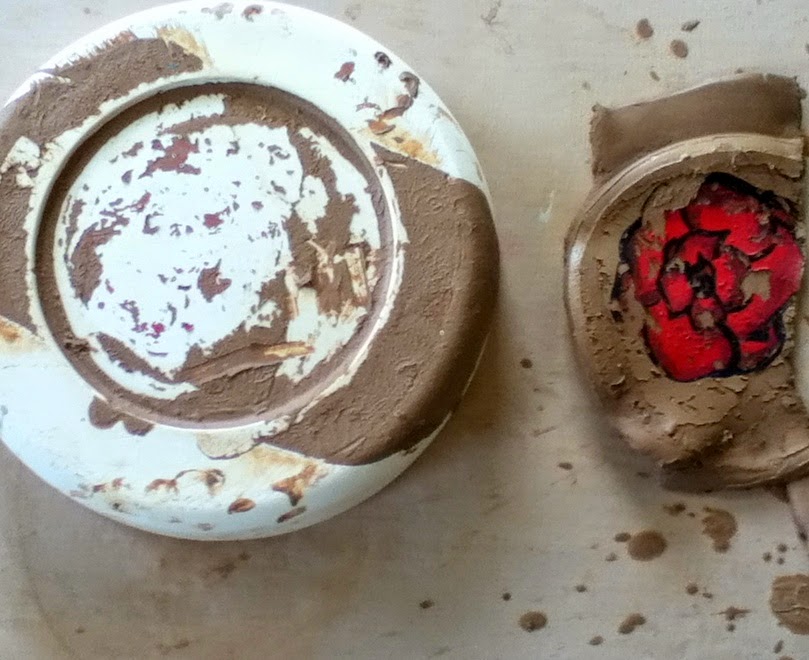
I tried out Chris Dufala's monoprint technique last night in class. (I have a long standing tradition of trying things for the first time in class. Hilarity ensues! Sometimes.) Chris has a detailed step-by-step at this link, which is way more helpful than my fumbles might be, so I'll just briefly describe what I did:
Paint an image on plaster. You have to think backwards, because whatever you paint first will be the top layer. So, the black outline and shading on the rose was what I painted first, and then the red behind it.
Let it dry to not-shiny. Pour thin slip of the claybody you are using over the image - a thin layer! My first mistake was using too much slip.
Slap an already-rolled slab quickly onto the slip layer. I found it helpful to compress the slab downward with a rib or fingertips. Maybe a roller.
Peel the slab up. God willing and the creek don't rise, your image will be on the other side!
My images only partially transferred, giving them a deteriorating, peeling-wallpaper kind of look.
You all know how I love the Law of Entropy! Deteriorating patterns & images are what makes my world go 'round. So I loved the little slab images too much to throw them away but they weren't big enough to make something out of themselves, so....Throw a pot to use them on!
This is what I love about going to NCECA, and workshops generally: when you can take someone else's technique, and use it to make your own work stronger. It's nothing like copying - what I make couldn't be further from what Chris makes, and the uses I hope to put this to are completely different from what he is doing.
Though this was an off-the-cuff pot, I can see this in future "real" work (as opposed to demos.) Maybe not with the tear-throughs...maybe cut windows, looking through at a peeling floral pattern.
Whatever it ends up being, you'll see it here first!
In many ways, the soaping process reminds me of clay work: the chemistry, the waiting, the big reveal. In one way, soaping reminds me of fiber art, which I spent some time in, in college. Back then I was always finding or making little bits of things - beads, buttons, dyed fabric - and saving them to use in some future project. I find that I do that with soap, too: each batch makes more soap than will fit in the mold, so I use the extra to pour into candy molds - like these little seashells - or tube molds for inserts, or just bricks of color. Then I get a design idea, and go through my saved-up materials to see what would make a nice grace note.
I find I always want a grace note, in this case the scattered shells, and the gold mica shimmer. That is what makes the bars special, sets them apart at a glance from a perfectly-serviceable bar you can get in the grocery store. (Most of those aren't actually soap; they are detergent, but for most people that's a big ol' whatever.) The chemistry is important, too - the soap needs to feel amazing, lather generously, smell delightful. Those are all function. People never get to experience that part, unless they look at the soap and think, want.
Like clay, a boring piece can serve the function just as well as a special one. The grace notes are what make using it a great experience.
These are on the curing rack, and will be available mid-September.
I've had some feedback about the Pots By the Pound equation, and it illustrates the value of listening to people who know what they are talking about! (Listening is a skill I had to cultivate. I used to get defensive about my ideas and push back on perceived criticism; it's hard to learn anything, that way.) Some input I will put in place, because it is a genuine omission which would ultimately have caused the approach to fail. Others were just things that I needed to think about: if they needed to be in there, and if not, why not?
To review, the pricing equation looks like this:
2 x BM(Bare minimum of household expense) + UFE (15% of BM, for unforeseen expenses) + S (20% of BM for savings) + BE (Business Expenses) divided by PC (pounds of clay I purchase annually) = wholesale price per pound for pots.
Firstly, someone pointed out that I have not accounted for failed pots. My numbers assume that 100% of the clay that I buy will result in a finished, salable piece. That is so not true! I lose at least 10% of my ware, though most of those become seconds rather than shards, due to normal parts of the clay process, like cracking and warping, accidental chipping of greenware or bisqueware, and glaze flaws; and a few more which are specific to vapor glazing: big crusty blobs of soda in the middle of a plate, for example, or a pot that received so little soda glass that the surface is dry and unappealing. There are also some pots that fail because I try something new and it doesn't go well. I don't know if 10% is high or low, but I know all potters have some percentage of kiln-god sacrifice. So the PC part of the equation will now be amended to PC = pounds of clay purchased annually minus 10%. This pays for the inevitable expense of making pots that then fail.
Another important point mentioned was that I should build into the equation expenses that are not unforeseen but not annual, either. Someday I will have to replace my kiln. Someday I will have to rebuild the kiln, whole or in part. That will have to be part of BE; I am thinking ten percent every year of the initial cost of those items, and any other big purchases I can think of that come around rarely but predictably.
A point that required more reflection: a friend pointed out, correctly, that this model contains no profit for Fine Mess Pottery itself. There's compensation for me, and (now) money that will be saved for future predictable expenses, but Fine Mess (in theory if not in practice) will have zero dollars on the books at the end of each year. It will generate enough to keep me happy and afloat, but no extra to expand. No future larger facilities, no apprentices, no second kiln. Apparently businesses are supposed to do this, plan money to grow.
Seems obvious, so why did I leave it out? I realized: I don't want to grow. I'll need to expand my market to reach the numbers this equation generates (will eventually generate, when I stop talking about it and put some actual numbers instead of letters into it) and presumably my expenses will go up a little each year, and I may discover some needs I didn't know I had, but I don't want or need my business to grow beyond how many pots I can comfortably make, with enough time to make them well. In a sense, if you think of my compensation as a salary, an expense which Fine Mess Pottery incurs (if we can for a moment separate the potter from the Pottery), Fine Mess is sort of...non-profit. Not in the legal sense, of course, but I have no interest in building an empire, however small.I have no shareholders to satisfy. I just want to make good pots and have a life free of oil-bill and car repair panic attacks.
I've been reading articles lately (here's one) on following your passion as a work/life choice, a topic which is very close to home for me. (Hey Captain Obvious! Missed you.) The full mantra is either "Do what you love. Love what you do" or "Do what you love and the money will follow." BWAAA-HAAAAA-HAAA-HA-HA!!! HAH! HA! HA!
Oh, my, let me catch my breathe a bit. That last one really hits me funny bone for some reason.
Smart assitude aside, I've been an advocate for this approach, never noticing the snobbery built into it. The aphorisms themselves suggest that if you find yourself doing a tedious or unpleasant job, it's because you were insufficiently dedicated to your passion. If only everyone would do what they love, then every job would be filled by passionate, enthusiastic people!
Except, no. Most jobs in the world are not especially lovable, but somebody still needs to do them. Somebody needs to assemble the iphones, if they are going to get assembled. Somebody needs to take away the rubbish. It's hard to imagine a person busing dishes as a calling because of their deep love of the work and dedication to being the best damn busboy ever. I'm not saying one should not do what they love; only that we should recognize the extraordinary privilege built into the freedom to make that choice.
Even me. Especially me.
I do what I love, yes. I make pottery and teach others to make pottery, and I love doing it. And the money has not followed from just loving what I do and my commitment to do it as well as it can be done, no. I've made the financial end work by hook or by crook, but it's an outright lie
to imply that just dedication to a passion will cause the world to
supply one with a living. The fact that we are still afloat owes much to middle class beginnings and privileges: I have a college education, and a mid-Atlantic accent that helps me interview very well when I have needed to grab a temp job to cover a shortfall. We made it through December because many of our Christmas presents were Hannaford gift cards (thank God), made possible because we have family who can afford to buy gift cards. Our car recently died, so we drove a vehicle borrowed from a friend who is traveling for a few months until we could replace it. Friends with resources are a privilege, too.
Right now I am struggling with whether I can continue to be potter in a full time way. This is not a pity party (although the next time I have one, you'll surely get a gold-plated invitation and a ringside seat; I do love me a good pity party.) This is an observation: part of my struggle here is a sense of shame, that I might have to lower myself to do work which is merely work. And that is bullshit.
There is no failure there. I want to get past the reverence for creative pursuits above more mundane ones which makes me feel I am wasting the Gifts of the Magi or something if I decide that the necessary thing for me and my family is for me to get an office job. No more than I am wasting my talents as a receptionist (and I can joke about it, but I really was a very good receptionist) by spending my days with muddy hands.
This isn't a big announcement, and more likely than not I will find a way to keep on keeping on, because I am stubborn as hell and maybe a little selfish. Instead, this is a shout-out to the folks whose work is purely work, an economic activity, and a reminder to myself not to devalue those whose jobs that are done of necessity rather than passion. If I join their ranks, I am still me, still a person, still making a contribution.
Sometimes someone else's thinking is so unlike your own that it throws you for a moment.
I have been working on this Kickstarter campaign ("Oh, what's that, Lori? You have a Kickstarter project? You should have said something! " said absolutely nobody at all.) While remaining optimistic, I have been prepared for the possibility that it will not reach its funding goal, and therefore fail, Kickstarter being an all-or-nothing deal. Since the project - to convert all my ^10 reduction soda glazes to ^6 reduction soda, hopefully seamlessly - is a really good idea, I plan to make it happen one way or another; which means thinking about how I will fund all those unprofitable test firings and glaze ingredients. How exactly that will happen is not what I am here to write about today.
Instead, my mind got hung up on something a friend (let's call him Mr. Business Guy) said to me when I mentioned this to him. He shook his head vehemently and said, "No. Work without a net. If you build yourself a backdoor, you won't push as hard; you won't try every possible avenue, call in every favor, take every reasonable action to make it happen."
This struck me at first as sort of nuts; my approach has ever been to always, always have a back-up plan. Why deliberately allow your options to be only either full success or absolute failure? He really is better at business than I am, though, which shows in our circumstances, so I was not inclined to dismiss this advice out of hand. Was Mr. Business Guy right? Do my Plans B hold me back? I think of the years I worked part time at an office job, unable to commit fully to the world of conventional work or to my true calling. Should I have made the leap years before, and let my terror of being homeless provide the impetus to success?
Maybe, if money was the sole bottom line. This is often how I come down on issues regarding business practices for artists. If would be so much easier if all we wanted was to make money. Easier, but so much duller. We serve dual bottom lines: money, as in, enough to live on; and our aesthetic: that which makes us artists in the first place. Having no financial plan b might have pushed me harder to sell pots; and it might have forced me to sacrifice the aesthetic bottom line.
The campaign is at 71% funding, with 10 days to go. There is reason to be optimistic, so maybe all this fretting over Plan B will be unnecessary. However, more generally, as an approach to business, to life, to accomplishing anything, I'm still on Team Back-up Plan.
I had another moment of clarity yesterday. That's two in a few short months! Keep em coming.
It went like this: I was in class trying out paste-slip decorating with a pastry bag, like cake decorators use. (More on that later.) My first efforts were a little sloppy, as were all the others, but the first ones more so. It crossed my mind that they appeared to be deteriorated, or weather-worn or...images flicked through my mind of crumbling Corinthian columns; tattered lace dresses with the beads coming off; Miss Havisham's wedding cake. Opulence decayed. Twang!! I heard, or rather felt the deep chord in my brain: my magic twanger. Suddenly it made sense. Why nothing will do but soda firing: I live for the pots that come out with parts of my careful decorating softened and undone by the vapor glaze. Why so many of my photos are images of decay.
Why soaps, the more elaborate the better; because, the moment you use a soap, however fabulous it may be, it immediately begins to dissolve. Why gardening, even - what is a garden except a monument to the cycle of decay and regrowth?
My Magic Twanger is the Second Law of Thermodynamics! This feels like discovering that your fairy godmother is in fact the goddess Nyx (perhaps not coincidentally born of chaos) or that your Secret Santa actually is Santa. Or, you know, Oprah.
The Law of Entropy doesn't account for all of it, of course: there's still the connection to bright, over-decorated, frivolous things sweets and circuses, which is a huge aspect in itself. Maybe I have more than one magic twanger, or maybe it's just highly nuanced. But still. I have to think some more about this. Entropy.
I hope my last post didn't come off as negative! I was actually feeling pretty good, in the way that a moment of clarity can make you feel, even if the conclusion you reach isn't the one you hoped for.
I didn't mean to be mysterious or foreboding about my upcoming change; all I've decided - although it still seems like a pretty big deal in my head - is that I am not charging NEARLY enough, not nearly. In the new year I will be increasing prices for most items by 40 - 100%. Maybe more, I need to do some math to come up with the actual numbers.This is intimidating for a couple of reasons, one internal and one external. Externally, it will probably mean connecting with all new vendors: I don't know if any of the stores currently carrying my work can sell the price points that I am talking about. I have a list in my head of higher-end outlets to approach, and will need to assemble a set of images and sample pieces that represent the body of work well. That's a bunch of work but -hey!- it's no harder than what I've been doing. (As an aside, if you have been considering a piece listed on the website, now would be an excellent time to grab that, before the new prices kick in.) The larger obstacle is internal.
Maybe it's my New England upbringing, but I have a naysaying voice in my head constantly muttering, "Who do you think you are? $250 for a teapot, I guess you think you're really something!" And so on. Just choosing to be an artist at all means pushing back on that voice, but I haven't yet learned not to tag on the disclaimer, to apologize for anything that might appear as prideful - such as charging a sustainable price for my work.
I can make a reasonable number of things without any pain. I can fill the kiln once a month, even if I throw every piece in it. That's what I want to do: I want to make fewer things, spend more time on each one, and get a better price for them. Here's what I don't want to do: contrive more and more ways to make more pots in less time, just so I can sell them for price that a thrifty Yankee would deem a bargain. I look at potters I admire: Adero Willard. Kristen Kieffer. Jeffery Lipton. Jennifer Mecca. Joy Tanner. These folks aren't apologizing for charging for their work and skill. Oh, but now the inner critic is howling: I dared mention myself in the same paragraph as this illustrious company. Maybe someday you'll be good enough to deserve a living wage, she says. But I doubt it.
Shut up, bitch.
Someday is today (well, technically, "someday" is January 1). Yeah, I know I'm not Kristen Keiffer or Joy Tanner, and I don't have to be self-loathing to be acknowledge that, but - dare I say it? - I'm a pretty good potter. It's time I started treating myself like a professional. I have to, because the other choice is not to be a potter at all.
"Discipline is remembering what you want.” David Campbell (whoever that is. )
While I agree with this sentiment, failures of discipline are not all bad! Case in point:
After circumstances conspired to thwart my plans to load the kiln during the day on Wednesday - a surprise vet appointment, a meeting that really needed to happen, and had already been re-scheduled twice - I tried to make myself finish loading Wednesday night, in the 15 degree dark. I was gritting my teeth, growling to myself,"No! I will not let this be de-prioritized!" And then I just thought, Fuck it, I'll do it tomorrow.
All I can think is how much happier I was, loading in the brilliant sunshine and above-freezing temperatures. The wadding wasn't freezing to the furniture; my hands weren't numb and dropping wads that I had to go search for, lest they ruin work below; I didn't make dumb mistakes due to tiredness. Of course, it also pushed the firing to Friday, unloading Monday, as I decided there was nothing to be gained by staying up all night firing. That would almost certainly have put me in bed with a migraine all day Friday. There's determination; then there's obstinance; and then there's plain old stupidity. Failure of discipline seems to be a bit of a theme this week: I also noticed, that, despite my best intentions, I can rarely make myself do any other productive thing while the kiln is firing. It's this weird kiln of Genesisian Seventh Day, pardon the blasphemy. I had big plans to clean up my studio (and house) and to get some pots made for the next firing cycle. The most useful thing I managed was a load of laundry. I spent most of the day reading a big book: The Better Angels of Our Natures: Why Violence has Declined, and napping intermittently, like a cat. And I can't say I regret it a bit.
You know how sometimes you get on a jag, and you just can't quit a particular technique? For me it's been facets, all of December so far...I don't want to hear about anything that isn't facets, and faceting. Something about the way the light, and then the soda vapor, hits those edges...I don't know. Jags are the best, in that they produce the best pots, although not always the most salable pots. I can already tell I am going to be sitting on a mountain of toothbrush holders when this is over. [Edit: Want one? Get one here.]They are good pots - at least I think so - but maybe a bit too weird for the common aesthetic. Sadly, how close one's own aesthetic hews to the common determines how easily things sell - how "accessible" they are, to use the art-school word. There's a sweet spot in terms of styling which is just a hair outside of ordinary or expected, enough to intrigue but not enough to challenge. To my mind most of the best pots fall beyond this zone, which only means we have to work harder to find the folks who will like them, or transform a broader audience into those people. Functional pottery is already more accessible than, say, minimalist sculpture, so our job is easier than it might be.
ANYWAY. How did I get talking about that? That isn't faceting. I want to talk about faceting. For these pots I used my wire tool, because it was there. I used to have a nice cheese cutter with a wavy wire that made a nice texture, but somehow I've misplaced it. I am considering going out in the garage and rummaging through my husband's fishing equipment for some of that clear plastic line, because the wire tool leaves a slight texture, and I want to see if I like the facets better without. (As an aside to Mainers: Have you noticed that nobody north of Freeport, or west of, say, Windham, actually parks their car in the garage? I have one of every single man-made thing, except a car, in my garage. Possibly because in the poorer areas of Maine, no one's car is worth garaging.
WHICH IS ALSO NOT ABOUT FACETING! These pots will hopefully be out on the 18th, in time for last-minute Christmas shopping. Toothbrush holder, anyone?
Spending so much time in the studio with only the hum of the wheel (and a parade of cats) for company allows my mind to wander down various coves and alleys of thought. Such as: what makes a successful business? No, really think about it.
Many people would say that the purpose of a business is to make money, and if it is doing so, it is a successful business, period. Too broad for you? Let's stipulate legally; and even go a step further, and say ethically, within conventional standards. Is it enough that this so-stipulated business is making money, to make it successful?
At the risk of sounding like the ghost of Jacob Marley, I've concluded that, no. That's ass backwards. A business has to acquire money, of course, but that is a step in the process of its purpose. Like this: the purpose of a power plant is not to create steam; instead, power plants create steam as a necessary step to achieve the end result: electricity. It's not correct to say steam is a side effect or a by-product; the creation of steam is a key step, without which the plant would not function. Money, in business, is like that. You want some money, and you need some money - you have to live. You can't do your job unless you have enough money to live on. Your business can't function if the people within it - including you - can't. But it's among the means, not the ends.
So, if the goal isn't money, what is it? I submit that the purpose of your business - the true purpose of any business - is a dual: to provide the best product or service that it can in the process of realizing of human potential. There is great overlap between these goals. The realization of your potential, the entrepreneur, is the utilization of your skills and knowledge. The same goes for your staff, if you have staff. A successful business will provide an opportunity for both the owner and the employees to realize the promise of their aptitudes. To the extent that the aquisition of money interferes with the actualization of either owners or employees, it is over-emphaiszed. It has become an obstacle to the success of the business.
Maybe you're waiting for the twist, the part where I conclude that, if you do business in this fashion you will make even more money, in the end. Well, you probably won't. You tend to get what you prioritze, and if you prioritize money only as an avenue to personal growth, your business may well make less money, and that's okay. Because I am advocating for a different model of success. If you have enough that you and your family are comfortable and secure, consider that perhaps you have enough, period.
Yeah, I hear you, there in the back: I should stop smoking that stuff, it'll make my teeth all yellow. But as Marley discovered, you really can't take it with you, and a legacy of material things is an impoverished one indeed. I'll let ol' Jake have the last word:
Get Exclusive Content, Discount Codes, & More on Patreon
For more videos & tutorials, early access to shop updates, and discounts on Fine Mess Pottery, become a subscriber at my Patreon page. Click the image to learn more!
Wishlist
Art tools & materials I'd love to try. Watch for posts about how these worked out.
https://a.co/6L6qZNo
Lori Keenan Watts (aka me) is a potter, gardener, and avid reader from Augusta, Maine. Though I started my university education in surface design for fabric, clay quickly grabbed me by the heart and redirected my creative impulses. I have been a potter for over 25 years -- hard to believe. The most valuable years of my ceramic education were spent in graduate study at Southern Illinois University at Edwardsville, under the tutalage of Dan Anderson and Paul Dresang.
My aesthetic is guided by my love of the material itself. What fascinates me and makes a pot compelling for me is the clay-ness of clay: the squooshiness that becomes the adamantine solidity. I also like patterns, unexpected proportions, and when the flame comes along and dissolves part of my careful decorating efforts! I am obstinate about this aesthetic, to a point which might be called pig-headed, but hey, if you don't like what you make, why bother?
My happy little family also includes my husband, musician and photographer (and author of the book Alewife) Doug Watts; five cats; and a turtle, all foundlings and rescues of one stripe or another.




 Posts
Posts

